
How Much Does a Custom CRM or Customer Portal Cost in 2026?
If you're budgeting a new CRM or customer portal, the first question decision makers ask is practical: how much will it cost? A useful estimate needs to reflect features, integrations, security, and ongoing operations. We use the term "custom CRM cost" here because price depends less on labels and more on scope and integrations.
This article gives CFOs, founders, and product owners three realistic pricing bands, feature lists per band, common integration and migration costs, recurring maintenance and hosting expectations, and a short checklist to qualify your project before you hire a development partner.
Why CRM/Portal costs vary (what moves the needle)
Several predictable factors change the custom CRM cost more than the choice of framework or vendor. We usually see the following drive both budget and timeline:
- Scope and workflows: The number of user roles, custom reports, and approval flows. A small sales-only CRM is a different project than a full customer service portal with multi-step billing.
- Integrations: Connecting to ERP systems, payment gateways, SSO, or industry-specific tools typically adds fixed integration engineering plus ongoing API maintenance.
- Data migration and normalization: Moving decades of customer records, removing duplicates, and mapping legacy fields often requires custom scripts and validation plans.
- Security and compliance: PCI, SOC2, HIPAA, or stricter encryption/hosting requirements can increase architecture and audit costs.
- UX complexity: Custom dashboards, admin panels, and responsive interactive components add design and QA hours.
- Reporting and analytics: Real-time dashboards or advanced reporting needs extra backend work and attention to performance.
- Team skill and delivery model: A senior, experienced team costs more per hour but reduces risk and rework. Fixed-price bids often include contingency for unknowns.
Understanding which factors matter for your business lets you convert a vague "how much" into a realistic budget range.
Common project types and feature sets
Most projects fall into predictable categories. We map them to the typical feature sets we see requested:
Small / Minimum Viable CRM
- Basic contact and account management
- Lead capture forms and simple pipeline tracking
- Basic role-based access (admin, user)
- CSV import/export and basic reporting
- Simple email notifications
Mid-market Customer Portal / CRM
Includes everything in Small, plus:
- Custom workflows and approval rules
- Integrations: accounting or billing system, single-sign-on (SSO)
- Custom reports and dashboard widgets
- Document upload and secure file access
- Mobile-responsive UI and admin controls
Enterprise Customer Portal / CRM
Includes everything in Mid-market, plus:
- Multi-tenant design or complex permissioning
- ERP integrations, payment processor reconciliation, SSO with SAML/Okta
- Audit logs, advanced reporting/BI exports
- Performance tuning, horizontal scaling, and DR planning
- Compliance controls (encryption at rest, retention policies)
Pricing bands and example budgets
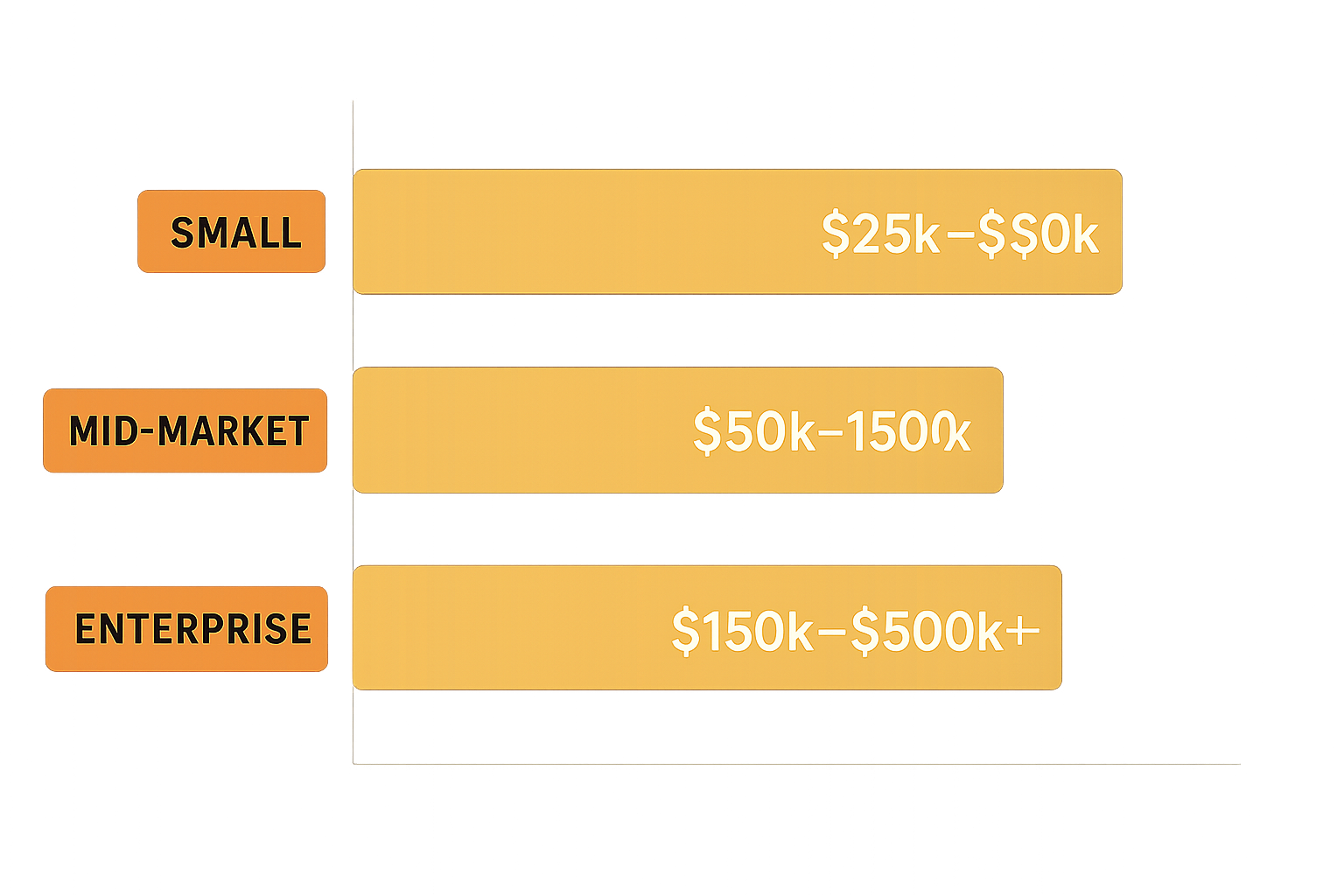
| Band | Typical features (concise) | Ballpark price range (2026) |
|---|---|---|
| Small / Minimum viable | Contact management, lead capture, basic reports, CSV import/export | $25,000 – $60,000 |
| Mid-market | Custom workflows, SSO, billing/accounting integration, dashboards, document handling | $60,000 – $150,000 |
| Enterprise | ERP + payments + SSO, multi-tenant or advanced permissioning, compliance, scaling | $150,000 – $500,000+ |
These ranges are illustrative. Integration complexity, compliance needs, and data migration can move a project from one band to the next. For example, a mid-market feature set with a difficult legacy ERP can easily push past $150k.
Summary: Start with the band that matches your core features and then add integration and compliance allowances.
Integration and migration costs to budget for
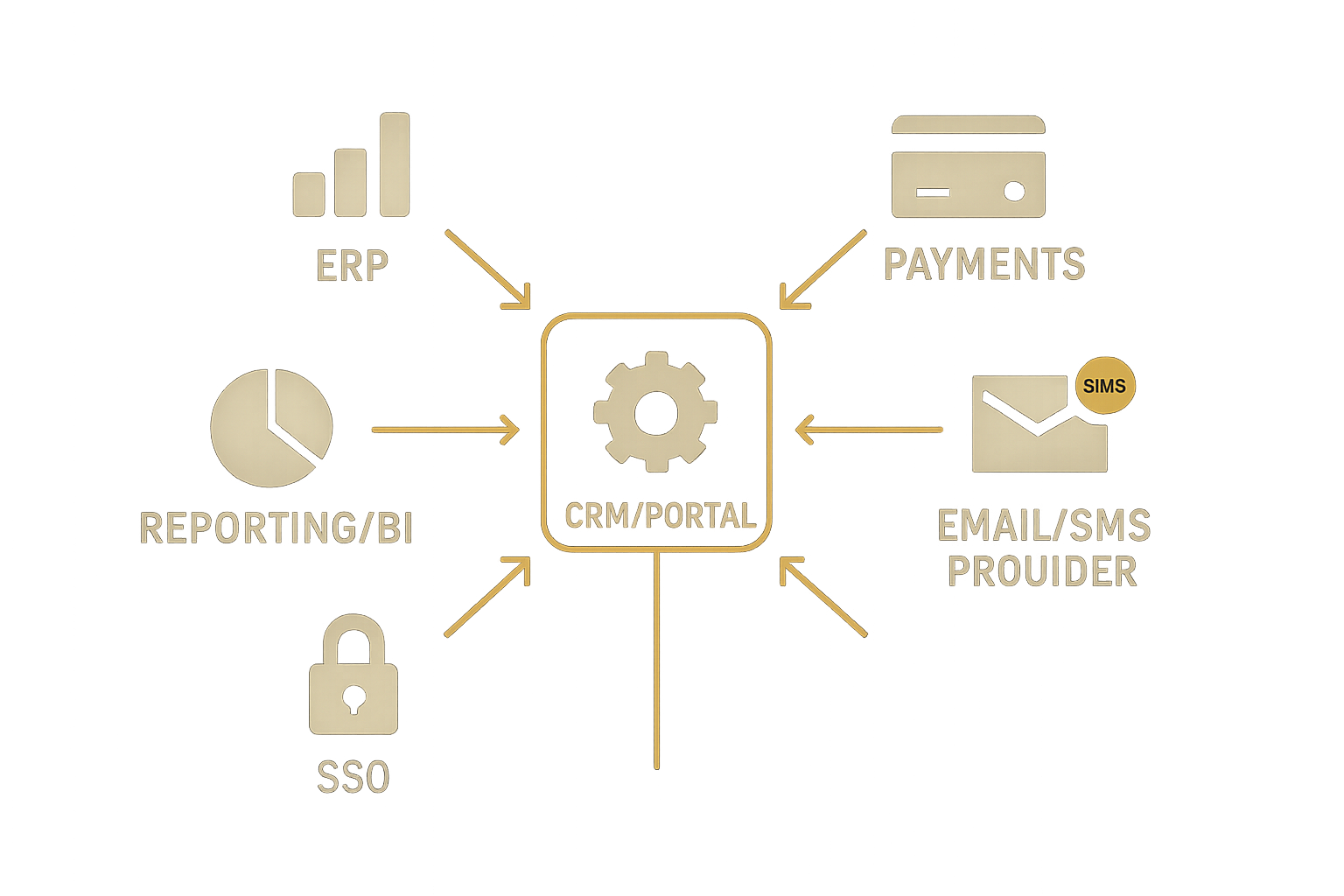
Integrations are where custom CRM cost is most variable. Typical costs we see:
- Simple SaaS integrations (Zapier-style webhook + basic API): $2k–$10k each.
- Payment gateway (checkout + reconciliation): $8k–$30k depending on custom reconciliation and PCI scope.
- SSO (OAuth/OIDC): $5k–$15k for common providers; SAML/Okta enterprise SSO can be $10k–$30k with testing.
- ERP integrations (SAP, Oracle, NetSuite custom endpoints): $25k–$150k+ depending on mapping complexity and batch vs real-time sync.
- Email / SMS providers and marketing automation: $3k–$12k, plus monthly provider costs.
- Data migration (CSV/SQL exports, dedupe, mapping, validation): $5k–$50k depending on volume and cleanliness.
Important: Integrations also add recurring obligations. APIs change, tokens expire, and endpoints move. Budget an annual integration maintenance reserve equal to roughly 10–20% of initial integration cost.
Ongoing maintenance & hosting (TCO)
Recurring costs are often overlooked when estimating the custom CRM cost. Typical annual ongoing costs include:
- Hosting and infrastructure: $1,200–$30,000+ per year depending on scale and high-availability needs.
- Monitoring, logging, and observability: $1,200–$12,000 per year.
- Security updates and dependency upgrades: $6,000–$40,000 per year depending on team size and complexity.
- Minor enhancements and backlog work: Plan 10–25% of the initial build cost per year for feature backlog and optimizations.
- Support and incident response: Dedicated SLA or on-demand support, often $2,000–$20,000 annually.
A practical rule we use when advising clients: expect total cost of ownership in year one to be around 1.25–1.5x the initial project cost (including launch support and any immediate fixes). In subsequent years, budget 10–25% of the initial build for maintenance and evolution unless you plan active product development.
Build vs Buy for CRM decisions
When evaluating build vs buy, weigh these tradeoffs practically:
- Time to value: Off-the-shelf SaaS CRM will be fastest for basic sales workflows. If you need bespoke workflows or customer self-service portals tied to your systems, custom may be the only reasonable path.
- TCO and lock-in: SaaS avoids upfront engineering cost but can produce rising subscription fees and limited customization. A custom build has higher upfront cost but gives control over integrations and data portability.
- Differentiation: If your CRM or portal is a core part of customer experience and competitive advantage, custom development pays off sooner.
- Compliance and data residency: Some SaaS options won't meet strict compliance or residency needs; custom builds allow specific architecture and controls.
- Hybrid path: Many teams start with a SaaS backbone and add a custom portal for unique workflows. We often recommend a hybrid approach when it shortens initial delivery while keeping key integrations under your control.
We would start qualifying a build decision by listing essential integrations, compliance needs, and user journeys. If those items are non-negotiable, custom is worth the higher initial cost.
Sample phased scope & timeline
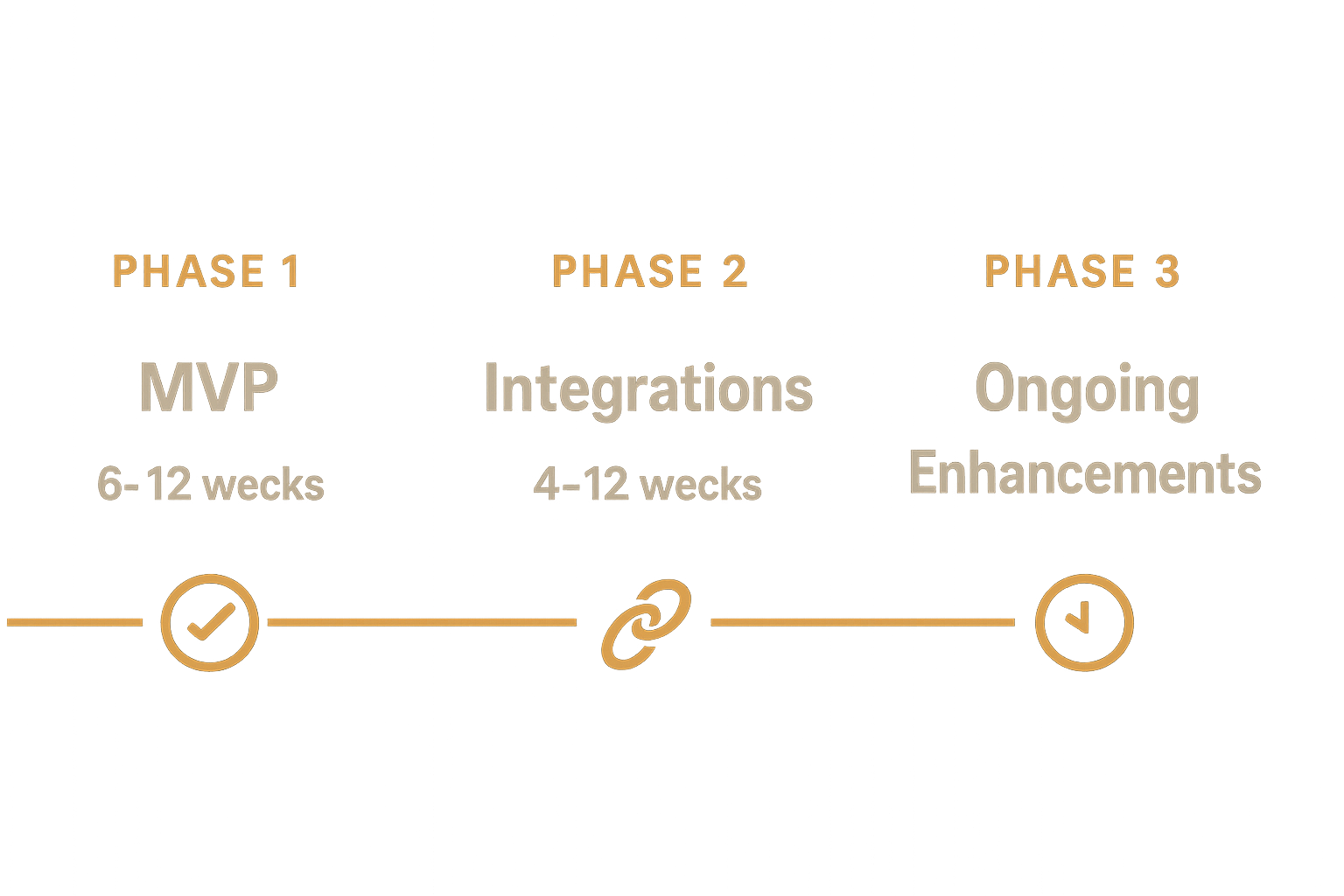
A phased approach reduces risk and spreads cost. Here are two realistic example scopes we deliver for clients with no identifying details.
Example A — Small CRM (Lean launch)
- Goal: Replace spreadsheets for sales team + basic lead capture.
- Phase 1 (6–10 weeks): Contact model, lead forms, pipeline UI, CSV import, basic reports, user roles. Launch MVP to 5–10 users.
- Estimated cost: $30k–$45k.
- Phase 2 (4–8 weeks): Email templates, simple SSO, basic automation rules. Estimated additional $10k–$20k.
Example B — Mid-market Portal with ERP sync
- Goal: Customer portal for order status, invoices, and self-service with ERP sync.
- Phase 1 (10–16 weeks): Customer portal UI, auth/SSO, order/viewing, document uploads, core APIs.
- Phase 2 (8–12 weeks): ERP integration for order sync and reconciliation, payment gateway integration, reporting dashboards.
- Estimated total cost: $90k–$180k depending on ERP complexity and reconciliation rules.
Phased delivery reduces upfront risk and lets you measure adoption before heavier integrations.
FAQ
How long does building a custom CRM or portal usually take?
A lean MVP for a small CRM can launch in 6–12 weeks. Mid-market projects commonly take 3–6 months across two phases. Enterprise projects with ERP and compliance often take 6–12 months or longer when data migration and audits are required.
What does data migration usually cost and require?
Data migration cost depends on volume and quality. Simple CSV imports and dedupe scripts can be a few thousand dollars. If data needs cleansing, normalization, or reconciliation across systems, budget $10k–$50k. Plan for discovery and validation cycles to avoid surprises.
How should I budget for security and compliance?
Start by identifying required standards (PCI, SOC2, HIPAA). Basic secure hosting and encryption are part of most builds, but formal audits, third-party penetration tests, or compliance readouts add $10k–$75k+ depending on scope.
Will integrations break later and add ongoing cost?
Yes. APIs change, tokens expire, and vendor updates can require maintenance. Budget annual maintenance of roughly 10–20% of your initial integration cost to keep connections healthy.
Can you provide a fixed-price estimate?
We can. A fixed-price estimate requires a clear scope, acceptance criteria, and a short discovery phase to surface unknowns. If you want a reliable fixed price, start with a scoped discovery engagement.
Which approach reduces long-term cost: build or buy?
There is no universal answer. Buy can be cheaper short-term for standard workflows. Build reduces vendor lock-in and can lower TCO where heavy custom integrations or differentiation matter. We help clients model both paths against their three-year financial plan.
Conclusion
Custom CRM cost depends on the features you need, the systems you must integrate with, and the level of security and compliance required. Use the pricing bands above to place your project and then add allowances for integrations, data migration, and ongoing maintenance.
If you're budgeting a CRM or customer portal, we can help scope the work, map integrations, and produce a fixed-price estimate. Learn about our services, review recent project examples, or contact us to schedule a short discovery call.Bold text